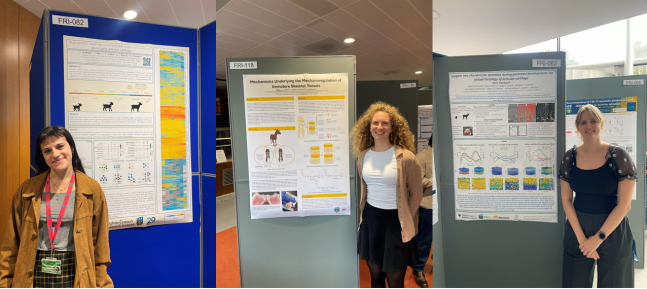
Giulia, Jemma, and Karin present posters at Conway Festival

We were delighted to see our very own Giulia, Jemma, and Karin represent the Developmental Biomechanics Group at this year’s Conway Festival of Research and Innovation at UCD. The two-day event was packed with engaging talks, inspiring posters, and plenty of good, solid science. The whole group was in attendance and made the most of the opportunity to connect with other researchers across Conway.

Giulia presented her poster, “A proteomic roadmap of extracellular matrix maturation in developing articular cartilage.” Her work identified around 800 proteins across seven postnatal stages of goat skeletal maturation, revealing a fascinating shift in cartilage composition over time. Early-stage cartilage was enriched with transient collagens and glycoproteins, while later stages showed increased regulators and stabilising proteins; marking a clear transition from matrix assembly to long-term tissue maintenance.

Jemma’s poster, “Mechanisms Underlying the Mechanoregulation of Immature Skeletal Tissues,” showcased her recent progress in developing and validating a single-cell RNA sequencing protocol to study how differential mechanical loading affects key skeletal tissues including the physis, articular cartilage, and ossification centres. Her pilot study provided important validation of the protocol’s robustness and generated valuable preliminary data, and her poster was noted for its clarity and technical depth.

Karin presented “Insights into chondrocyte dynamics during postnatal development: 3D virtual histology of articular cartilage.” Using synchrotron-based phase contrast tomography, she explored developmental changes in chondrocyte organisation and morphology during cartilage maturation; key processes in extracellular matrix formation. Her poster featured striking 3D renderings and heat maps of cell number, volume, and orientation, offering fresh insights into cartilage development in three dimensions. Karin also presented her work as a presentation as part of the PhD/Post-doc seminar series in the school of Mechanical  Engineering at UCD. 

We’re incredibly proud of Giulia, Jemma, and Karin for showcasing their exciting work and representing the group so brilliantly at this year’s festival.
Collaborative research published: Dynamics of postnatal bone development and epiphyseal synostosis

A paper describing our collaborative work with Dr Joel Boerckel’s group in the University of Pennsylvania, USA has been published in Developmental Dynamics! Congratulations to lead author Dr Christopher Panebianco and all co-authors!

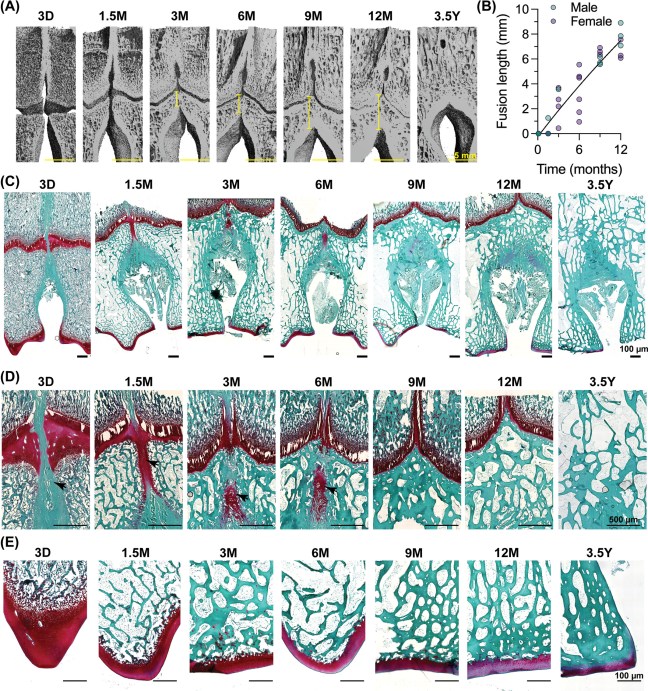
In the research, we investigate how the bones of the lower forelimb of the goat develop from after birth until maturity (older than two years for the goat).

What we found was that the cortical (shell) of the first phalangeal bone (P1) bone – the first digit in the forefoot of the goat- increases in density quickly after birth, while the thickness of that shell increases continually until skeletal maturity. The polar moment of inertia of the bone (a measure of how easy or hard the bone is to twist) is constant over time, indicating that the mechanical performance of the bone adapts along with the weight of the goat as it grows. In the trabecular (spongy) bone, we found that the number and thickness of the trabeculae increase until sexual maturity (12 months) in the P1 bone, while the trabeculae in the metacarpal bone increase in thickness and not as much in number.

One of the most surprising results related to the synostosis (fusion) of the ends of the distal metacarpus. Unlike humans, the goat forelimb has two metacarpal rudiments (early bones) during embryonic development, and these rudiments undergo synostosis prenatally to form one metacarpal bone at birth. It is thought that the fusion of these bones brings about greater strength in bones especially for activities involving a lot of bending. Fusion happens both in the straight part of the bone (the diaphysis) and also at the joint end (the epiphysis). Fusion in the diaphysis happens prenatally, but we found that – for the first time- that fusion of the ends of the bone happened postnatally, prior to skeletal maturity, through an interesting type of bone formation.

Welcome Aoibhin, Ellie and Neha to Summer Research Roles

We are delighted to welcome three student researchers to the group for the summer. We are excited to have them on the team and hope they all enjoy their summer research experience with us!

Ellie Mulligan joins us from the University of Galway where she is a Year 3 Biomedical Engineering student. She will work with the team on analysing microCT data of juvenile cartilage.

Neha Natu, a UCD medical student who has been working with the team, especially Hannah, over the past two summers, returns this summer to work on a paper about the morphology of the hip joint in children with and without Perthes disease.

Last but not least Aoibhin Corridon, is a UCD Radiography student who is working on a paediatric orthopaedics project in collaboration with Dr Siobhan Hoare and Prof Connor Green. Her project focusses on data collection for understanding the normal trajectory of paediatric hip joint shape over childhood.

PhD Position in Developmental Biomechanics of Cartilage Available

Funding is available for a fully funded PhD position in UCD in Ireland from May or September 2022. This PhD project will investigate how mechanical loading affects postnatal development of articular cartilage in a goat model system. The research will involve an exciting combination of biological, imaging and engineering techniques. There will be opportunities for international travel and collaboration. 

Candidates can be from anywhere in the world. The project will be in close collaboration with the UCD Veterinary School and co-supervised by Prof Nowlan and by Prof Pieter Brama. The studentship includes stipend of €18,000 per annum (tax free) and fees (EU or international). Funding is available for four years.

Applicants should have a first class or upper second class degree (ideally a Masters) in Biomedical Engineering, Biomedical Science, Medical or Veterinary Sciences, or a closely related discipline. Candidates should have a keen interest in working with translational animal models, and also in the biomechanics of the musculoskeletal system.

To apply, please send a CV and a cover letter summarising your experience and your interests in this specific PhD project to Prof Nowlan. The position is open until filled. Come join us at UCD!