Niamh contributes to Nature paper on evolution of bipedalism

Niamh was delighted to collaborate with Dr Terence Capellini’s group in Harvard and contribute to their work on how changes in the ilium contributed to the evolution of bipedalism.

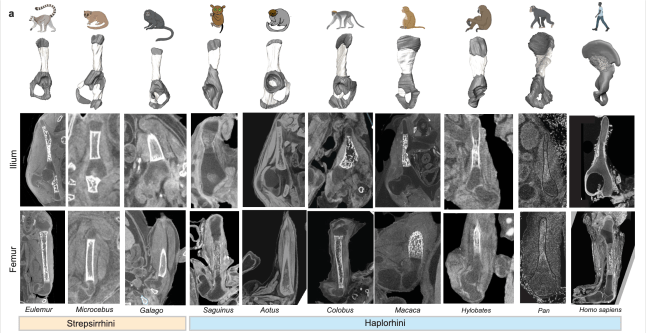
The upper part of the human pelvis, known as the ilium, underwent two major structural innovations during evolution that enabled humans to walk on two legs, a Nature paper reveals. The study lays the developmental and genetic groundwork for the human-defining trait of bipedalism. The ilium is the big, flared part of the pelvis that anchors the powerful gluteus maximus muscles that humans use to stay upright. Differences in the illum between humans and other hominins are a defining evolutionary feature. However, the developmental processes that led to the unique human ilium shape remain unknown.

The team, led by Dr Terence Capellini, Harvard University, used histological, anatomical, and functional genomic approaches to reveal how the structure acquired its unique shape. One key change involved the direction of cartilage growth. A shift in the orientation of the cartilage growth plate (physis) enabled the ilium to sit perpendicular to the direction seen in ilia from other animals. A second key change involved the process of bone formation. The authors identify timing and spatial differences in the way that bone cells are laid down over the cartilage in the human ilium, compared with non-human primate ilia and human long bones. Both innovations are interconnected at tissue and molecular levels. Hundreds of regulatory sequences were identified that are active during the development of the human ilium. These show evidence of human evolutionary change, suggesting that key complex, interacting sequences were selected for through time to endow the human pelvis with its unique shape.

Niamh’s involvement in the study centred on a dataset of 3D postmortem imaging data from human embryos and fetuses that she had assemebled together with Prof Owen Arthurs, a paediatric radiologist from Great Ormond Street Hospital in London and UCLH, to characterise hip development in 3D. When Niamh met Terry at a conference, he was excited to hear that Owen and I had a dataset that his team could use to characterise how the shape and ossification of the ilium changes over early human development. His team linked this with their extensive data and research on pelvic development in the human embryo and in other animals.

Read the paper here.
Collaborative research published: Dynamics of postnatal bone development and epiphyseal synostosis

A paper describing our collaborative work with Dr Joel Boerckel’s group in the University of Pennsylvania, USA has been published in Developmental Dynamics! Congratulations to lead author Dr Christopher Panebianco and all co-authors!

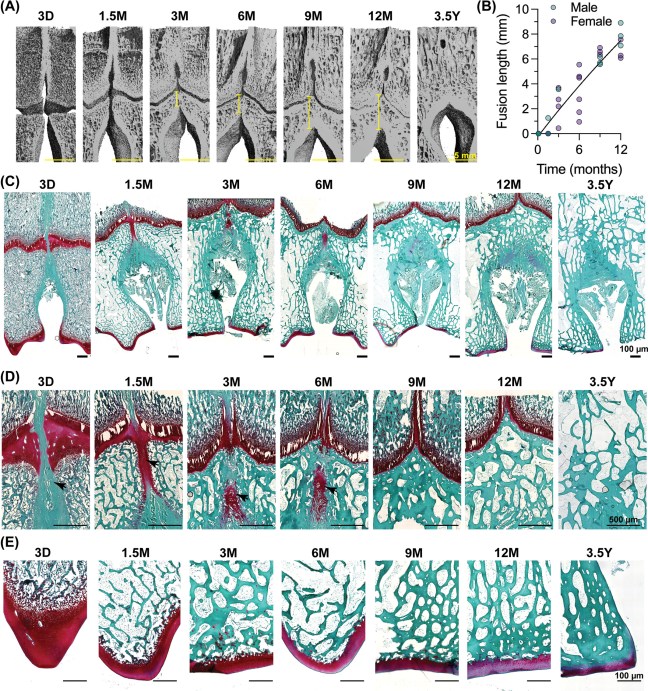
In the research, we investigate how the bones of the lower forelimb of the goat develop from after birth until maturity (older than two years for the goat).

What we found was that the cortical (shell) of the first phalangeal bone (P1) bone – the first digit in the forefoot of the goat- increases in density quickly after birth, while the thickness of that shell increases continually until skeletal maturity. The polar moment of inertia of the bone (a measure of how easy or hard the bone is to twist) is constant over time, indicating that the mechanical performance of the bone adapts along with the weight of the goat as it grows. In the trabecular (spongy) bone, we found that the number and thickness of the trabeculae increase until sexual maturity (12 months) in the P1 bone, while the trabeculae in the metacarpal bone increase in thickness and not as much in number.

One of the most surprising results related to the synostosis (fusion) of the ends of the distal metacarpus. Unlike humans, the goat forelimb has two metacarpal rudiments (early bones) during embryonic development, and these rudiments undergo synostosis prenatally to form one metacarpal bone at birth. It is thought that the fusion of these bones brings about greater strength in bones especially for activities involving a lot of bending. Fusion happens both in the straight part of the bone (the diaphysis) and also at the joint end (the epiphysis). Fusion in the diaphysis happens prenatally, but we found that – for the first time- that fusion of the ends of the bone happened postnatally, prior to skeletal maturity, through an interesting type of bone formation.

Welcome Aoibhin, Ellie and Neha to Summer Research Roles

We are delighted to welcome three student researchers to the group for the summer. We are excited to have them on the team and hope they all enjoy their summer research experience with us!

Ellie Mulligan joins us from the University of Galway where she is a Year 3 Biomedical Engineering student. She will work with the team on analysing microCT data of juvenile cartilage.

Neha Natu, a UCD medical student who has been working with the team, especially Hannah, over the past two summers, returns this summer to work on a paper about the morphology of the hip joint in children with and without Perthes disease.

Last but not least Aoibhin Corridon, is a UCD Radiography student who is working on a paediatric orthopaedics project in collaboration with Dr Siobhan Hoare and Prof Connor Green. Her project focusses on data collection for understanding the normal trajectory of paediatric hip joint shape over childhood.

US-Ireland R&D Partnership Programme Funding Success

Funding success for the Developmental Biomechanics group through the US-Ireland R&D Partnership Programme was announced today. The tripartite scheme enables researchers and teams from the Republic of Ireland, Northern Ireland and the USA to collaborate on ambitious research collaborations.

Our research focusses on how maternal exercise has a positive effect on development of the bones and joints in the unborn baby. We believe that our research could eventually lead to a prenatal intervention for babies at risk of abnormal skeletal development such as for example arthrogryposis or hip dysplasia. More details on the research are available here. The team is led by Niamh, Dr Joel Boerckel in the University of Pennsylvania, USA and Prof Gareth Davison in Ulster University.

The UCD news feature is linked here. We are very grateful to Research Ireland and the HRB for their support of the activities in the Republic of Ireland, and also to our partners’ funders; the NIH in the US and the HSC in Northern Ireland.

Welcome New Team Members

The Developmental Biomechanics Group has expanded dramatically this summer! We have been extremely lucky to have been joined by a fantastic set of summer researchers and research assistants, who have already got stuck in to their various projects. We hope they have a fun and rewarding stint in the group and look forward to the seeing exciting results and data down the line.

Let’s meet our wonderful new team members:

Neha Natu has just finished third year of medicine in UCD and is doing a summer research project on the factors associated with the use of steroids and osteoporosis (weak bones) in paediatric patients. Neha is also working on segmenting different tissues from MR datasets.

Roisin Ryan has finished second year of the Biomedical Health and Life Sciences degree programme at UCD. Her summer research project is generously funded by an Undergraduate Summer Vacation Research Scholarship from the Anatomical Society Her project is entitled “How does hip joint size and morphology, and skeletal age, influence the risk of avascular necrosis in the paediatric hip?”.

Gavin Griffin and Thomas Byrne are both working as part of a collaborative initiative between UCD and Northeastern University in the USA. Collaborating with Dr Sandra Shefelbine, the project is entitled “Mechanical Evaluation of Cartilage Hierarchy and Neo-Organisation”. Gavin is a graduate of the ME in Materials Engineering here in UCD, and Thomas has just completed second year of Mechanical Engineering also in UCD.

Last but not least, Páraic Ó Ciaruáin is the first appointment on the “ReZone” ERC Consolidator Grant. Páraic is a recent graduate from the ME in Biomedical Engineering in UCD, and will be helping us get started with mechanical testing and rigs for our key animal model. Páraic did his thesis project in the group and we are delighted to have him back with us full time.

Karin presents at the 2024 European Society of Biomechanics in Edinburgh

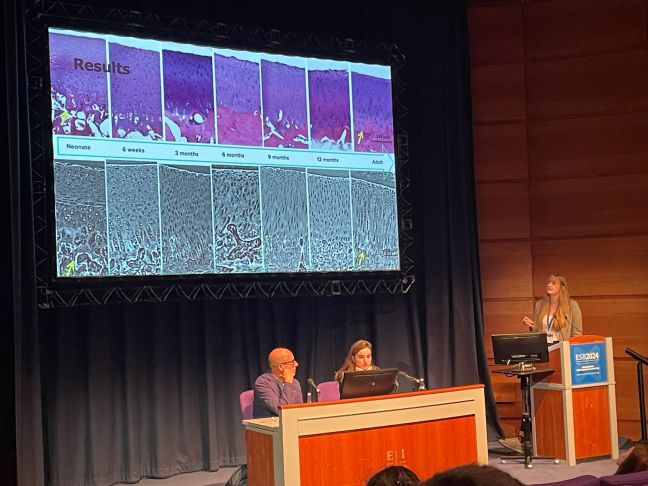
Congratulations to Karin who presented a talk entitled “Mapping Changes In Chondrocyte Organisation Over Postnatal Development Using 3d Virtual Histology” at the 2024 European Society of Biomechanics Meeting in Edinburgh. The work is a collaboration between the team in UCD and researchers in the University of Lund in Sweden and in Diamond Lightsource in the UK. Karin is using high resolution synchrotron data of juvenile articular cartilage to understand how cartilage matures over postnatal development, and in particular when and how the density, size and arrangement of chondrocytes matures.

Undergraduate summer researcher Roisin Ryan awarded funding from Anatomical Society

Congratulations to Roisin Ryan, a student of UCD’s Biomedical Health & Life Sciences (BHLS) programme, has been awarded funding from the Anatomical Society for a summer research project in the Developmental Biomechanics Group. The Undergraduate Summer Vacation Research Scholarships provided by the Anatomical Society offers bursaries to enthusiastic undergraduate students to undertake research in the Anatomical Sciences in the summer vacation. Roisin’s project is entitled “How does hip joint size and morphology, and skeletal age, influence the risk of avascular necrosis in the paediatric hip?” and is a collaboration with Prof Connor Green and Dr Siobhán Hoare. Many thanks to the Anatomical Society for funding Roisin’s project, and welcome to the group Roisin!

Let’s learn more about Roisin, in her own words:

I’m Roisin Ryan and I’m from Limerick. I am going into my third year of the Biomedical, Health and Life Sciences course in University College Dublin and helping to conduct research on the topic of Perthes’ disease for the summer. When I’m not doing college work, you can probably find me in a bookshop or concert venue in Dublin!

Seed Funding Awarded for Collaboration with Northeastern University

Prof Nowlan has been awarded seed funding together with Dr Sandra Shefelbine in Northeastern University, USA, to kick off an exciting new collaboration. Sandra and Niamh were colleagues and collaborators together at Imperial College London, and are very excited to be able to collaborate together again. The project is entitled “Mechanical Evaluation of Cartilage Hierarchy and Neo-Organisation” and will characterise the sequence of events by which the structure, composition and function of articular cartilage emerge over postnatal development.

Full details of the partnership scheme and the five funded projects are described here.

Prof Nowlan awarded ERC Consolidator Grant

Prof Nowlan was awarded >€2 million through a prestigious ERC Consolidator Grant. The ‘ReZone’ project, aims to bring about enhanced regeneration of Articular Cartilage through activation of the developmental processes which form zonal functional cartilage in early life, and ultimately improve quality of life for patients with articular cartilage defects worldwide.

Professor Nowlan said: “I am thrilled and very grateful to be awarded an ERC Consolidator Grant. This will enable us to understand how mechanical loading affects the development of cartilage, with implications for both cartilage regeneration and for orthopaedic conditions affecting children. Articular cartilage is an amazing material that we depend upon for pain free movement. Due to its poor healing ability, cartilage needs to last a lifetime. What makes healthy cartilage low friction and long-lasting is its complex layered (zonal) structure, but current surgical techniques to fix damaged cartilage cannot recreate the original structure. Therefore, repair cartilage tends to break down, leading to the need for further surgeries and possibly even joint replacement.”

“In the ReZone project, we will find out how the zonal structure of cartilage forms after birth, and in particular how mechanical loading affects the cartilage layers. Through discovering how articular cartilage grows and develops, we hope to be able to (re)activate those processes in adults to be able to truly regenerate articular cartilage and help patients suffering from joint pain across the world. I would like to thank all of the people who helped in the preparation of the proposal, and all my collaborators. In particular I would like to acknowledge my key collaborator Professor Pieter Brama with whom I am excited to continue working closely. I would also like to acknowledge my funding sources to date in UCD, especially Science Foundation Ireland and Wellcome Leap”.