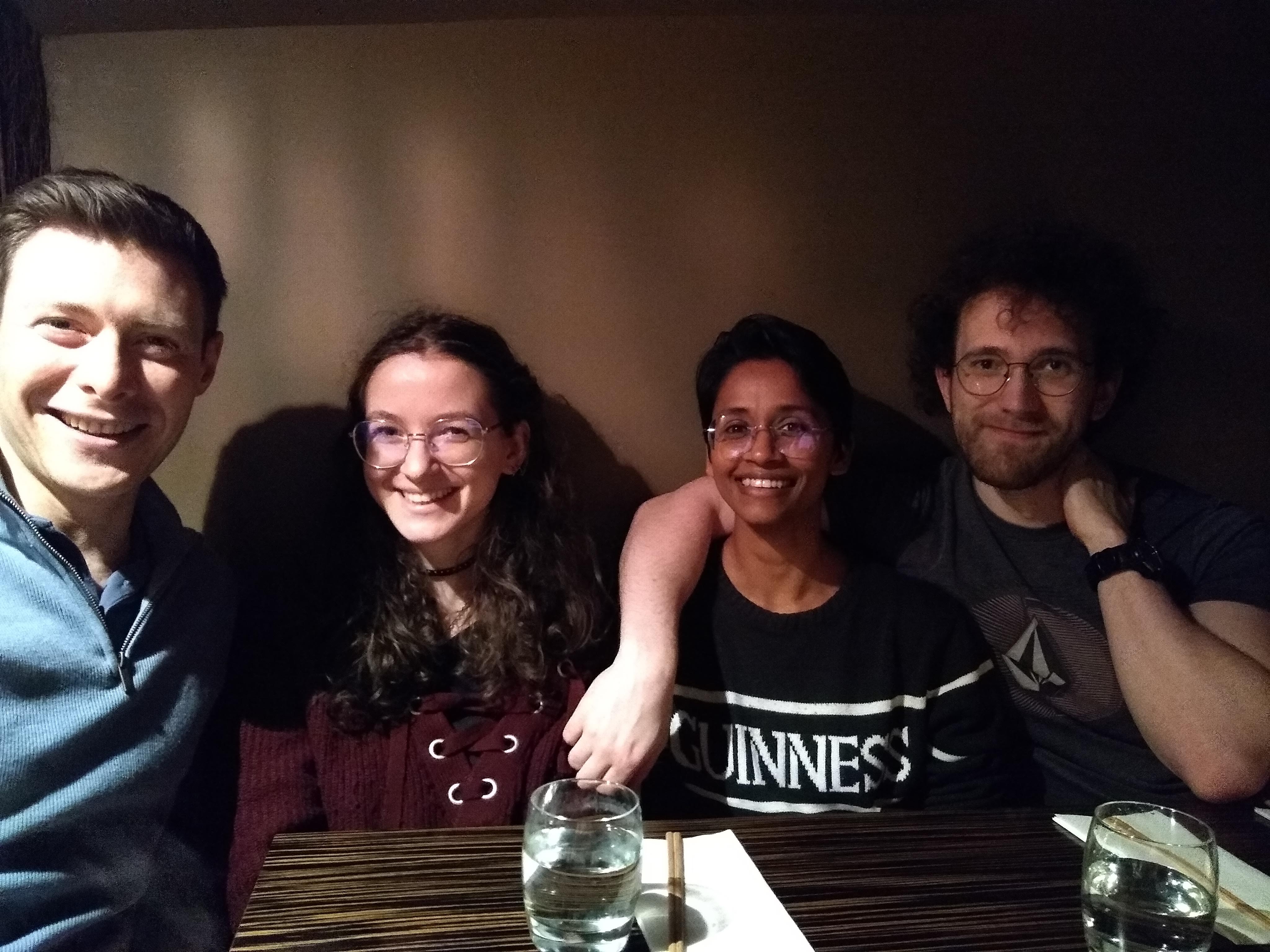
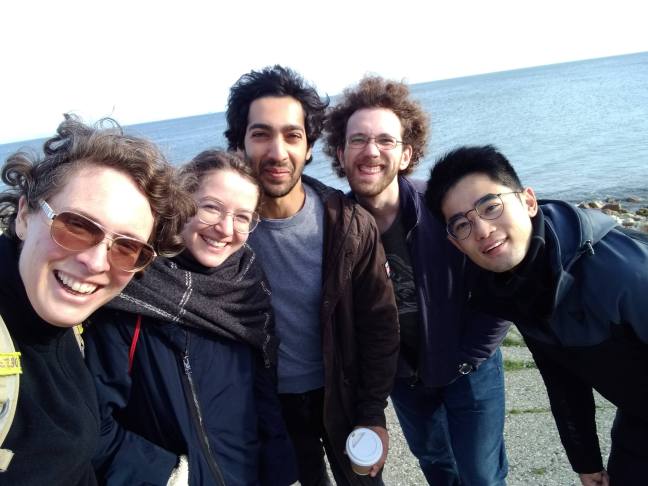
In picture (from left): Niamh, Karin, Sophie, Pieter, Sarah, Margot and Namdev.
To thank our summer student Sophie Oatley and to treat ourselves after a busy schedule of tissue sampling, the extended group went for a nice lunch in the UCD University Club. Best of luck to Sophie as she continues her Biomedical Engineering studies in the University of Cambridge!
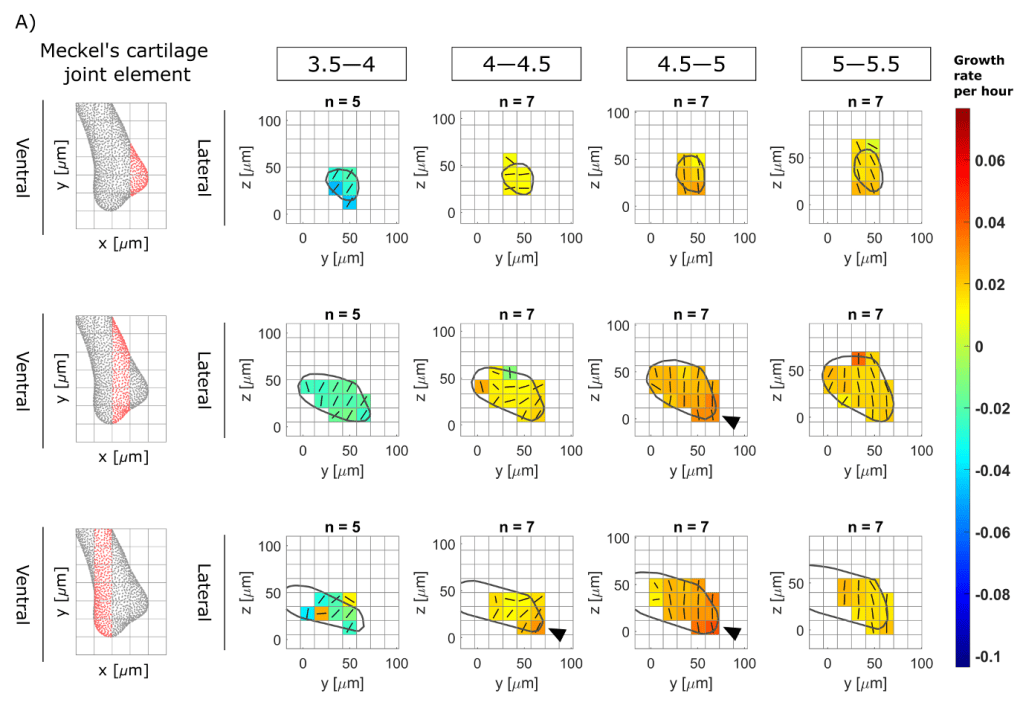
Jo‘s first first-author paper entitled “Growth orientations, rather than heterogeneous growth rates, dominate jaw joint morphogenesis in the larval zebrafish” was published in the Journal of Anatomy. Read the paper online here (open access).
In this research, a collaboration with Dr Chrissy Hammond (Bristol, UK), we tackle a long running question: what cell activities determine embryonic joint growth & shape?
We tracked individual cells in 3D in the larval zebrafish jaw joint over a 48-hour window. Using changes between cell centroids, we constructed growth maps of rate and direction of local tissue deformations
Growth maps varied substantially in growth orientation and growth rates both spatially at each developmental time point, and over the duration of development studied.
We synthesised the growth rates in a finite element analysis simulation, which was able to accurately predict joint morphogenesis. What this means is that cell positional information (i.e., orientation and volume) over time is enough to approximate growth and shape change. Then, we were able to use the simulation to test the importance of growth orientation, versus heterogeneous growth rates. We found that growth orientation was much more important for shape than growth rate heterogeneity.
Thank-you to the Anatomical Society for funding Jo’s PhD and congratulations Jo and all the team on a lovely study and paper!
Niamh was recently interviewed by the Orthopaedic Research Society (ORS)- check out the link below to get a personal insight into her research, career path, involvement with the ORS, and more!
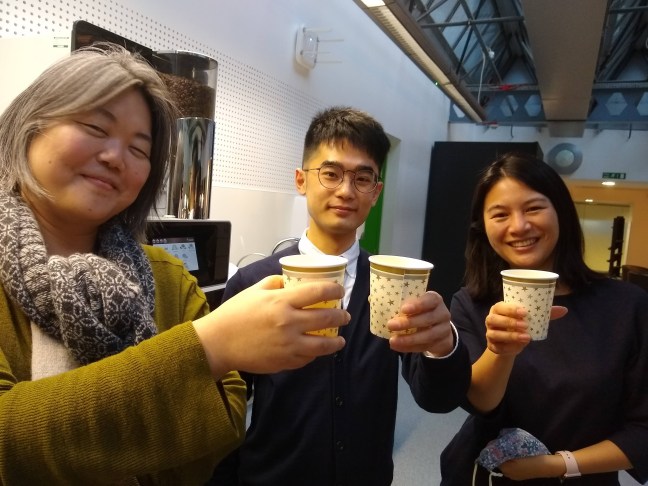
Many congratulations to Yuming who passed his PhD viva (pending minor corrections) last week! Many thanks to examiners Dr Yanlan Mao and Dr Naomi Nakayama. It was so lovely to celebrate together as a group and in person after so long without being able to mark occasions properly.
Stefaan, Jo, Devi and JamesNidal, Yuming and Niamh
Niamh presented a seminar entitled “How to Grow an Elbow” in the Department of Bioengineering at Imperial College London on the 9th of March, in the company of all the featured researchers (James, Jo, Nidal and Yuming). The seminar is available to view online on YouTube.
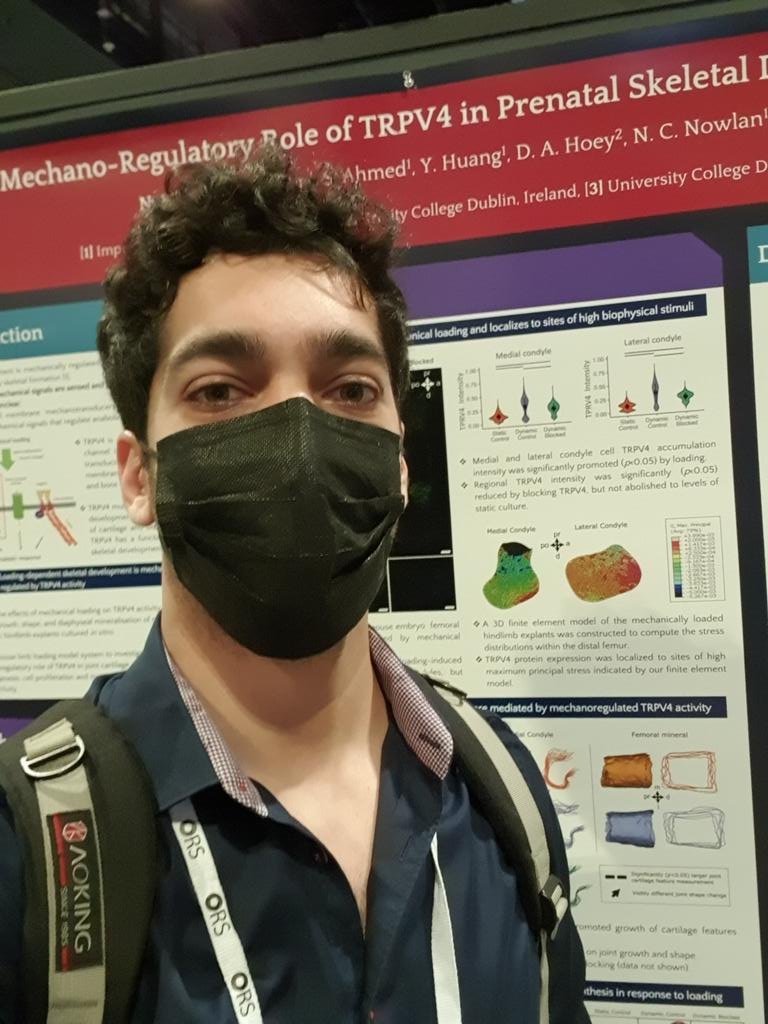
Nidal was awarded the prestigious New Investigator Recognition Award (NIRA) from the Orthopaedic Research Society (ORS) at their 2022 Annual Meeting in Tampa, Florida, USA. NIRA finalists present a poster and give a podium presentation and are interviewed by the NIRA committee, and award recipients chosen based on quality and presentation of material. Awardees receive a certificate and a generous cash prize. Many congratulations Nidal on the fantastic achievement!
Nidal at his poster. Nidal hanging out at his posters with fellow NIRA nominees.
Funding is available for a fully funded PhD position in UCD in Ireland from May or September 2022. This PhD project will investigate how mechanical loading affects postnatal development of articular cartilage in a goat model system. The research will involve an exciting combination of biological, imaging and engineering techniques. There will be opportunities for international travel and collaboration.
Candidates can be from anywhere in the world. The project will be in close collaboration with the UCD Veterinary School and co-supervised by Prof Nowlan and by Prof Pieter Brama. The studentship includes stipend of €18,000 per annum (tax free) and fees (EU or international). Funding is available for four years.
Applicants should have a first class or upper second class degree (ideally a Masters) in Biomedical Engineering, Biomedical Science, Medical or Veterinary Sciences, or a closely related discipline. Candidates should have a keen interest in working with translational animal models, and also in the biomechanics of the musculoskeletal system.
To apply, please send a CV and a cover letter summarising your experience and your interests in this specific PhD project to Prof Nowlan. The position is open until filled. Come join us at UCD!
Listen to Niamh discuss her path to research and how it was influenced by her own orthopaedic conditions, and her career so far from 🇮🇪 to 🇺🇸 to 🇪🇸 to 🇬🇧 to 🇮🇪 . Part of the UCD Conway Institute‘s CLASS Acts podcast series. Thanks to Dr Eoin Cummins for being an expert interviewer!
The Developmental Biomechanics Group finally met in person again in November 2021, when the London contingent travelled to Dublin for three days. The retreat kicked off with a beautiful hike around Howth Head on a windy but lovely and sunny day. James kept Niamh distracted from the steep cliff edges and Kinder Buenos kept the blood sugar levels up. The walk was nicely rounded off by some traditional fish and chips at the harbour. The next two days were filled with in-depth updates from the seasoned group members. It was so great to be together again and discuss all the exciting data everyone has been gathering over the pandemic.
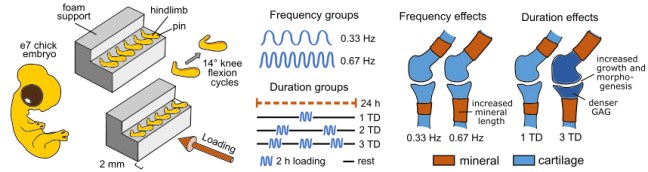
In the paper we investigated how frequency and duration of loading affect cartilage and bone development. We used an in vitro explant culture system to culture embryonic chick limb explants under a range of loading regimes in which the amount of loading and the frequency were systematically varied. We found that increasing the duration (amount) of loading promoted cartilage growth, shape development and mineralisation of the femur and tibiotarsus. However, varying frequency only had significant effects on mineralisation, and not on cartilage growth or shape. Increased glycosaminoglycan deposition and cell proliferation may have contributed to the accelerated cartilage growth and shape change under increasing loading duration. The results demonstrated that frequencies and durations of applied biomechanical stimulation differentially promoted cartilage and bone formation, with implications for developmentally inspired tissue engineering strategies aiming to modulate tissue construct properties.
The work described in this paper was funded by an ERC Starting Grant. Congratulations Nidal and Cristian!







 Developmental Biomechanics